Ice Maker Repair
Sub-Zero Ice Maker Max Ice: What It Does and When to Use It
Max Ice on a Sub-Zero raises ice production by up to 30% for 24 hours, then the ice maker drops back to its normal pace. Here is how to switch it on, what the louder running sound means, and which settings make a working ice maker look broken.
Written by
Warren Ibarra
Refrigeration technician — condenser and heat-load work · 20 years in the trade
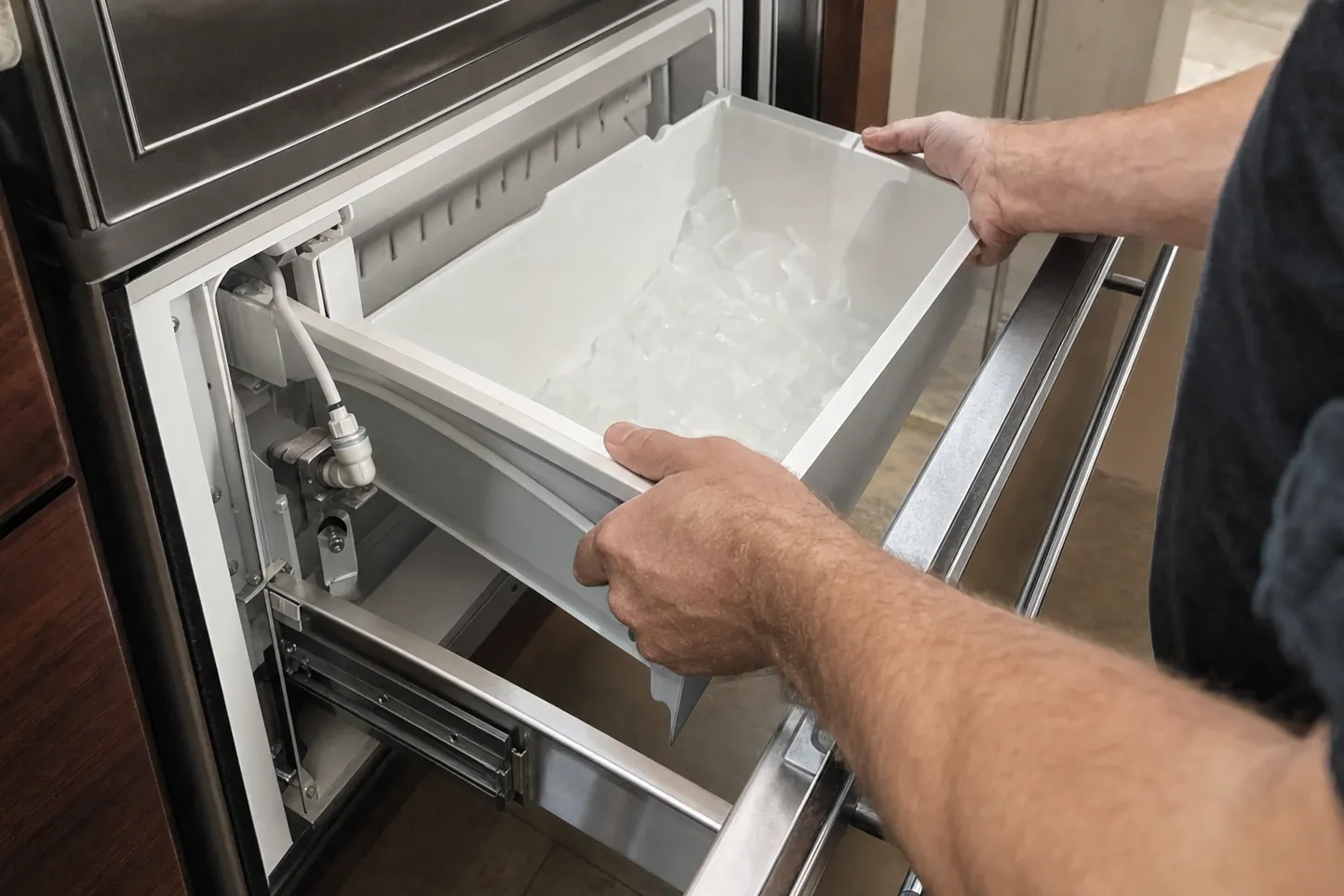
Max Ice is a short-term boost. Turn it on and a Sub-Zero ice maker produces up to 30% more ice over the next 24 hours, then quietly returns to its normal pace on its own. It is meant for the day before a gathering or the morning after the bin has been emptied into a cooler, not for leaving on all the time. In a Phoenix summer, when iced drinks run from breakfast to bedtime in homes from Estrella to South Mountain, it is the quickest way to catch up without anything being wrong with the machine.
What the Max Ice setting changes
Sub-Zero describes Max Ice as lifting production by as much as 30% across a 24-hour window. To get there, some components run faster than usual, and the owner’s guides say plainly that you will hear the difference: a steadier hum, more frequent cycling and cubes landing in the bin more often. That sound is the feature doing its job, not a part on its way out.
Because the boost builds over the whole 24 hours, switch it on a full day before you need the extra ice, not an hour before guests arrive. There is nothing to undo afterward: the ice maker resumes its standard rate by itself, which is why some owners decide the setting has failed when it has simply finished.
Checking whether Max Ice is on
How the display shows it depends on the model. The IW-30CI, along with Classic (BI) and Designer (IT, IC, ID) models, uses a small ice cube symbol. A lone cube tells you ice production is running normally; a row of three tells you the boost is active. If no cube appears at all, the ice maker is switched off, and no amount of waiting will fill the bin.
On Classic (CL) and Designer (DET, DEC) touch controls, Max Ice is chosen on the panel itself, and your use and care guide shows the exact steps. Either way, read the display before assuming a fault.
Settings that make a healthy ice maker look broken
| Symptom at the bin | Probable setting | Next step |
|---|---|---|
| Ice pauses after you pull the bin | The bin removal delay | Seat the bin fully and wait a few minutes |
| No ice and no door alarm | Sabbath Mode is on | Turn Sabbath Mode off at the control |
| Undercounter unit stops for hours | DELAY or Auto Delay on a UC-15I | Clear the delay or set it again |
| Slower output after a busy day | Max Ice has used up its 24 hours | Switch it on again if needed |
The bin delay
Classic (CL) and Designer (DET, DEC) ice makers hold off for 3 minutes once the bin comes out. If you are tipping the bin into a cooler for a backyard party, that pause is normal. If the bin will stay out for a long stretch, say while you wash and dry it, Sub-Zero’s advice is to turn the ice maker off first and back on once the bin is in place again.
Sabbath Mode
With Sabbath Mode engaged, the door alarm goes silent and the whole ice making system stays dormant for as long as the mode lasts. It also outlasts a power cut: when the electricity returns, the unit drops straight back into Sabbath Mode rather than normal running, which after a monsoon outage can leave a bin empty with nothing visibly wrong. On Classic (CL) and Designer (DET, DEC) models the mode ends by itself after 74 hours, but checking the display is far quicker. Our guide to restarting a Sub-Zero after a monsoon outage covers the rest of that hour.
DELAY and Auto Delay on the UC-15I
The UC-15I undercounter ice maker has a DELAY key that pauses production: one press gives 2 hours, two presses give 4 hours and three presses give 8 hours. Auto Delay, programmed while the unit is off, repeats that pause every 24 hours, handy for a quiet bar area overnight. After a power outage it must be set again, so the nightly pause vanishes until you reprogram it. The UC-15I has no Sabbath Mode, so on that model a sudden stop points elsewhere.
Filters, cleaning and Phoenix water
Phoenix tap water is hard, and the same minerals that spot your glassware slowly coat the inside of an ice maker. A fresh filter helps, and the UC-15I tells you when one is due by lighting REPLACE FILTER in red after 8000 ice-making cycles. Its filter is part 7042803, which superseded the older 7012333. Sub-Zero recommends changing it every six months, after a prolonged shutdown, or whenever the red light shows, and then touching and holding the clean key for 6 seconds to clear the reminder. Running Max Ice often adds cycles, so expect that light a little sooner during a busy summer.
For a basic clean on any model, switch the ice maker off, empty the bin, wash it in warm water with a mild dish soap, dry it and slide it fully home before switching the ice maker back on. Skip harsh chemicals on anything that touches ice.
When Max Ice will not fix it
Max Ice speeds up a working ice maker; it cannot revive a stuck one. If the display shows the ice maker is on, no delay or Sabbath setting is active, and the bin is still empty a full day later, something in the fill or freezing path needs attention. The same goes for water on the floor, cubes that come out hollow or tiny, or a grinding noise that sounds nothing like the steady hum of Max Ice. Before calling, confirm the water shutoff behind or under the unit is open and the supply line is not pinched against the wall.
If that does not explain it, our Sub-Zero ice maker repair visits cover Alhambra, Garfield, Estrella and South Mountain. Every visit begins with a flat $89 service call that includes the full diagnosis, and that amount comes off the repair once you approve the work. As a guide, an ice maker, water valve or supply line repair typically runs $270–$860, with the firm quote given after diagnosis. Call (623) 323-6690 or use the booking button on this page.
Follow-up questions
- How long does Max Ice stay on?
- Max Ice runs for one 24-hour period, after which the ice maker settles back to its usual rate without any input from you. If you need extra ice again the next day, switch it on again rather than expecting the boost to carry over.
- Is it normal for the ice maker to sound louder on Max Ice?
- Yes, some components run faster while Max Ice is active, so a steadier, more noticeable sound is expected. Grinding, rattling or a harsh buzz while no cubes are dropping is a different matter and deserves a proper diagnosis.
- What is the simplest way to restart an ice maker that has gone quiet?
- Switch the ice maker off at the control, leave it for a few minutes, then switch it back on and give it a full day to refill the bin. Make sure the bin is pushed all the way in and that Sabbath Mode or a DELAY setting is not quietly holding production back.
- What makes a Sub-Zero ice maker drip or leak?
- Leaks usually trace back to a fill tube that has frozen or clogged, a supply line that is loose or kinked behind the unit, or a water valve that no longer shuts off completely. If water is pooling, close the shutoff valve and have the fill path checked.
- What does a repair usually cost if Max Ice does not help?
- Repairs to the ice maker, water valve or supply line typically fall in the $270–$860 range, with a firm price only once the fault is diagnosed. The visit opens with a flat $89 service call covering the full diagnosis, and those $89 come off the repair bill if you decide to go ahead.