Wine Cooler Repair
Sub-Zero Wine Cooler: One Zone Drifting Warm in a Phoenix Summer
A dual-zone wine unit whose upper zone creeps warm while the lower one holds is rarely a dead compressor. What the panel is not telling you, how to verify it with a cheap thermometer, and which faults are worth a visit.
Written by
Warren Ibarra
Refrigeration technician — condenser and heat-load work · 20 years in the trade
Wine storage fails politely. A refrigerator that stops cooling announces itself by Thursday; a wine cabinet drifts a few degrees, holds there, and nobody notices until a bottle that should have been fine is not. In this valley the drift almost always starts in the same month, and it is usually the upper zone that goes first.
That is not a coincidence, and it is not normally a compressor.
Verify the drift before you diagnose it
The panel on the front is reporting what a sensor tells the board. It is one measurement, in one place, and it is the first thing to check rather than the thing to trust.
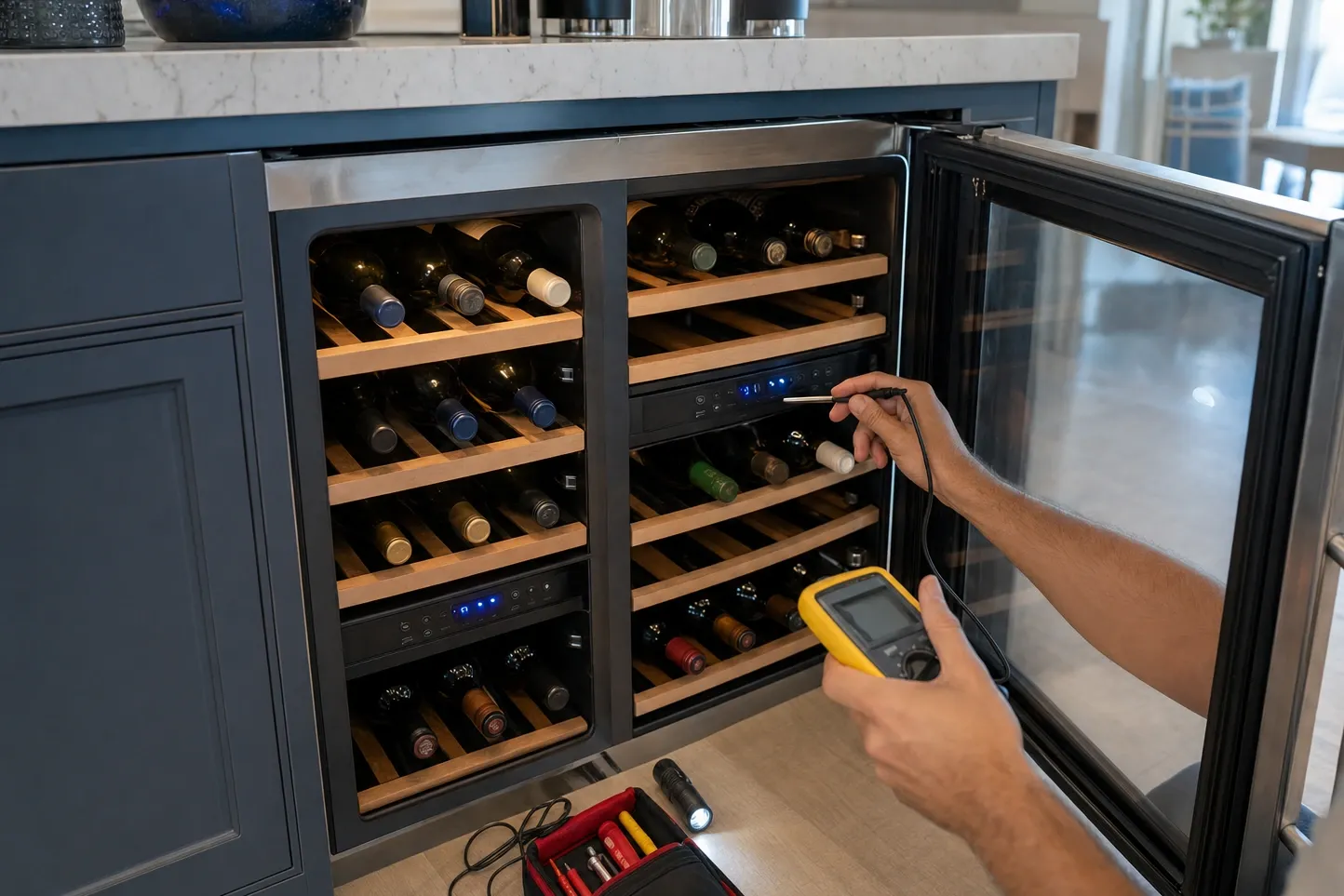
Put an independent thermometer — a cheap probe one is fine — on a shelf in the middle of the zone you are worried about. Leave the door shut for four hours and then read it. Do the same in the other zone. Now you have three numbers: what the panel claims, what the upper zone is really doing, and what the lower zone is really doing.
Three patterns come out of that, and they point in different directions:
- Panel and thermometer agree, upper zone warm. A real cooling or airflow fault in that zone. Read on.
- Panel claims correct, thermometer says warm. A sensor or board reading problem — the cabinet believes it has already done its job.
- Both zones warm by a similar amount. Not a zone fault at all. That is a whole-cabinet problem: condenser, airflow, ambient heat, or refrigerant.
Why the upper zone is usually the one that fails
On most dual-zone cabinets the two compartments are fed from one cooling source, and the split is managed by a damper, a second fan, or both. The upper zone generally sits further from that source along the air path.
Anything that weakens airflow therefore shows up in the upper zone first: a damper motor that has stalled part-open, a circulation fan slowing down, a duct that has been partly blocked by a bottle pushed too far back. The lower zone carries on looking fine and the fault reads as “one zone broken”, when what has actually happened is that the cabinet no longer has enough airflow for two setpoints at once.
Phoenix makes this worse in a way that is specific to the housing here. A great many of these cabinets are built into an island or a bar run with almost no clearance behind, in a room with a west-facing window. The cabinet has to reject its heat into air that is already warm, and the first thing to suffer is the zone at the end of the air path.
Check what you can reach
Before booking anything, there are four things worth looking at, and none of them need tools:
- Clearance and airflow. Is the front grille clear? Can you feel warm air leaving it? A cabinet in a closed cupboard run, or with a decorative panel over the vent, is being suffocated.
- Loading. Bottles pressed against the rear wall block the very air path that feeds the far zone. Pull the back row forward an inch.
- The door. Close it on a sheet of paper and pull. If the paper slides out with no resistance anywhere along the seal, the gasket is not sealing there. Look for a seal standing proud of the frame, or a hinge that has dropped.
- Dust. Same story as every other refrigeration cabinet in this city: the condenser mats over with fine dust, and a matted coil cannot reject heat.
If clearing all four changes nothing over 24 hours, the fault is inside and it is measurable rather than guessable.
What we actually find on these calls
Ranked roughly by how often it turns out to be the answer:
- Stalled or lazy damper motor on dual-zone cabinets — the classic warm upper zone over a healthy lower one.
- Circulation or condenser fan slowing, seizing, or running with a cracked blade. Cheap part, obvious once gauges and a meter are on it.
- Sensor or thermistor reading out of range, so the board stops calling for cooling in a zone that is genuinely warm. This is the one that makes the panel a liar.
- Door seal, hinge and glass alignment, which shows up as condensation and a zone that cannot hold rather than one that never cools.
- Refrigerant restriction or a leak — the least common and the most expensive. Diagnosed under gauges, never from a symptom, and worth an honest conversation about whether the cabinet is worth the work.
- Loose feet, mounts and resonating panels for noise complaints, which are quoted as compressors far more often than they should be.
When it is worth a call
If the wine matters to you, the trigger is stability rather than a specific number: a zone that wanders more than a couple of degrees through the day, or one that will not come back to setpoint after a warm afternoon, is a cabinet that has lost its margin. In a Phoenix summer that margin does not come back on its own.
Call when the independent thermometer disagrees with the panel, when condensation keeps returning after the door has been checked, when a zone will not come down at all, or when a cabinet that was quiet has started to buzz through a wall. Those are all measurable in one visit, and knowing which of them you have is the difference between a fan and a sealed system.
Follow-up questions
- What temperature should each zone be set to?
- Reds around 55°F and whites around 45°F is the usual split, and it is what most dual-zone cabinets are designed to deliver. What matters more than the exact numbers is stability: a zone wandering three or four degrees through the day does more harm to a cork than a steady setting a little off ideal.
- Why does condensation form inside the glass door?
- Humid air is reaching cold glass. In a Phoenix summer that usually means a door seal sitting proud, a hinge out of adjustment, or a door being opened often in a room that is more humid than the cabinet. It is worth fixing early — persistent moisture attacks labels long before it affects the wine.
- Is a buzzing cabinet a failing compressor?
- Usually not. Loose mounting feet, a compressor mount that has relaxed, or a back panel that resonates account for most noise complaints we are called out for. A compressor genuinely on the way out tends to change how it starts, not just how loud it is.